Wellpoint dewatering systems
The workhorse of Central Florida groundwater control: closely spaced small wells, a header pipe and a vacuum pump that pull the water table below your excavation before the first bucket comes out.
Lake Monroe Dewatering designs, jets and operates wellpoint systems across Sanford, Seminole County and the north Orlando metro. In our sands a wellpoint system is usually the right call anywhere you need more than a couple of feet of drawdown: utility trenches, building pads, footers, lift station pits and stormwater structures.
The system works by suction. Wellpoints go into the ground at 3 to 6 foot spacing along the excavation, each one a small screened well jetted to depth with water pressure. A header pipe ties them to a vacuum-assisted pump, and within a day or two the water table under your dig drops into a smooth curve below the working depth. Soil that was quick and boiling becomes firm, trench walls hold, and pipe bedding compacts the way the spec assumes.
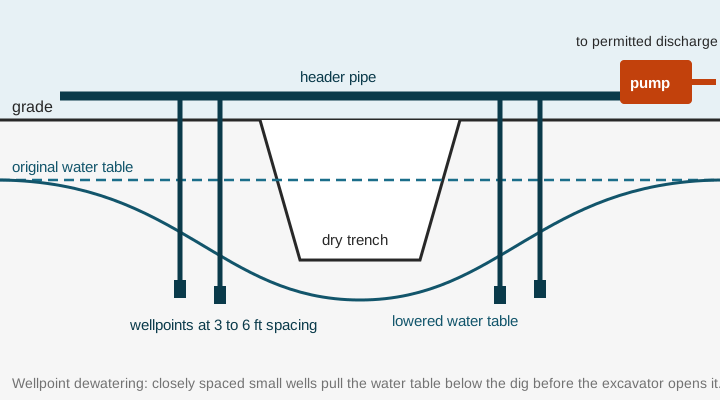
The honest limit is suction lift. A single stage draws down about 15 feet; past that, physics wins and the system gets staged, with a second header set on a bench partway down the cut. Deep excavations are engineering exercises and we scope them that way, with your geotech report on the table.
Discharge is part of the job, not an afterthought. Pumped groundwater runs through settlement and turbidity control to a point covered by the FDEP Dewatering Generic Permit notice we file. Estimators who forget the discharge path in the bid meet it later as a change order; ours is priced up front.
Published wellpoint pricing
Wellpoint system, utility trench run (up to ~100 ft of header)
$3,000 to $8,000
Moves the price: trench depth below the water table, soil fineness, how far the discharge has to travel.
Wellpoint system, building pad or foundation excavation
$8,000 to $30,000
Moves the price: footprint size, drawdown depth, single or double stage, weeks on the pump.
Every job type is on the full cost page, including rental and emergency rates.
What does a well point dewatering system cost?
A well point dewatering system costs $3,000 to $8,000 to set up on a utility trench of about 100 feet around Sanford, and $8,000 to $30,000 on a building pad or foundation. Longer trenches add $2,500 to $7,500 per extra 100 feet. Pump rental with fuel and maintenance is billed on top at $1,900 to $3,300 per four weeks.
The setup price covers jetting the points, the header and pump, discharge with turbidity control, the permit notice and pulling the system at backfill. Sample budgets for a 100 foot lateral, a 300 foot storm run and a lift station pit are in our well point dewatering system cost breakdown.
What makes a well point system cost more?
Depth, soil and time. A cut deeper than about 15 feet below the water table needs a second stage. Fine sugar sand needs points every 3 feet where clean sand takes them every 6. A long run to the legal discharge point adds pipe and a settling tank. And every four weeks the hole stays open is another rental block, so a slipped pour costs real money. Wet season work from June through September prices higher in the range for the same cut.
Wellpoint questions
How far apart do wellpoints go in Florida sand?
Typically 3 to 6 feet. Fine sugar sands around the Econ basin and lake margins need the tight end of that range; cleaner sands can spread out. Spacing is the difference between a trench that stays dry and one that seeps, so we set it from the soil, not from a habit.
How long does a wellpoint system take to install?
One to four days to jet the points and set the header for a typical trench or pad, then a day or two of pumping to pull the water table down before digging starts. Plan about a week from plans in hand to dry dirt.
What does a wellpoint system cost?
A trench run starts around $3,000 for the first hundred feet of header, additional footage runs $2,500 to $7,500 per hundred feet, and foundation or pad systems run $8,000 to $30,000. The cost page lists what moves each number.
Can wellpoints run on electric power instead of diesel?
Where site power exists, yes, and electric drive is quieter and cheaper to run for long durations. Most first mobilizations start diesel and switch when temporary power lands. We spec it in the quote either way.
Price a wellpoint system
Address, depth, and what you are digging. We answer with a range off the published table, usually the same day. Related work: utility and trench, excavation and foundation.